简体中文
简体中文
 English
 عربى
عربى
Content
- 1 Steel Stamping Parts Define Vehicle Safety and Efficiency
- 2 Material Grades That Maximize Strength and Ductility
- 3 Precision Manufacturing Through Progressive and Transfer Stamping
- 4 Designing for Impact Energy Management
- 5 Balancing Lightweight Construction With Structural Demands
- 6 Practical Considerations for High-Quality Stamped Parts
Steel Stamping Parts Define Vehicle Safety and Efficiency
Automotive steel stamping parts form the load-bearing skeleton of every modern vehicle. Their ability to combine high-volume consistency, precise dimensions, and engineered crash performance directly determines body stiffness, occupant protection, and overall manufacturing cost. Without advanced stamped steel components, lightweight construction and mass production targets would be unattainable.
From outer panels to deep-drawn structural reinforcements, stamped parts are designed to channel impact forces along predetermined paths. This controlled deformation is the bedrock of passive safety, making the stamping process far more than a forming step—it is a safety system in itself.
Material Grades That Maximize Strength and Ductility
Choosing the right steel grade transforms a stamped blank into a crash-optimized structural member. The shift from mild steel to advanced high-strength steels (AHSS) allows engineers to increase strength while reducing thickness.
| Steel Type | Min. Yield Strength (MPa) | Typical Tensile Strength (MPa) | Example Components |
|---|---|---|---|
| Mild Steel | 140–280 | 270–400 | Inner door panels, brackets |
| High-Strength Low-Alloy (HSLA) | 300–550 | 400–700 | Frame rails, reinforcement brackets |
| Dual-Phase (DP) Steel | 300–700 | 800–1200 | B-pillar reinforcements, front rails |
| Press-Hardened Steel (PHS) | 1000–1300 | 1500–2000 | Side-impact beams, A-pillars, roof bows |
Press-hardened steels with tensile strength above 1,500 MPa are now standard in occupant survival spaces because they resist intrusion while enabling thin-gauge stampings that save weight. Dual-phase grades excel in front rails, where a balance of strength and elongation absorbs energy progressively.
Precision Manufacturing Through Progressive and Transfer Stamping
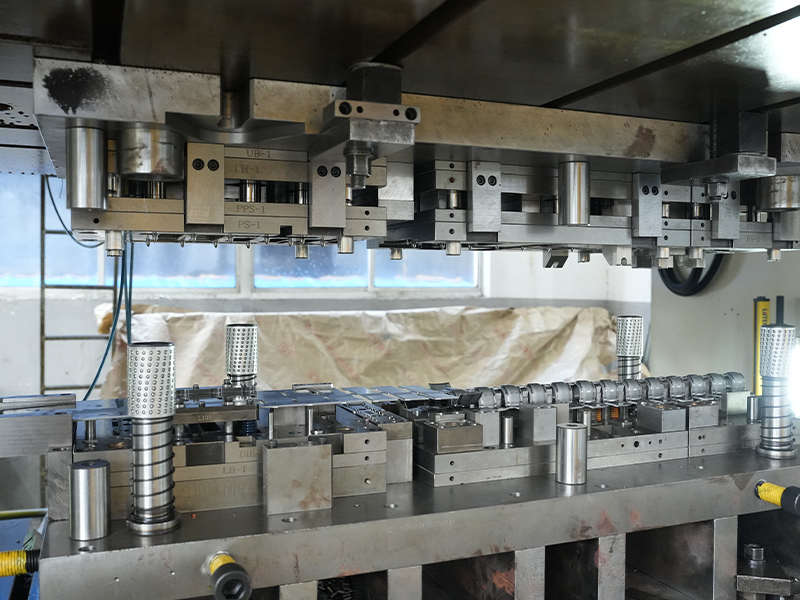
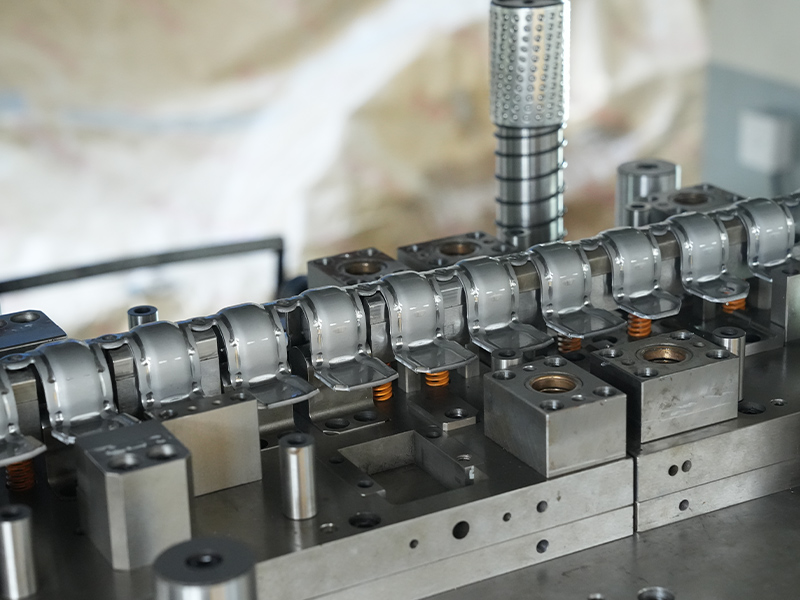
High-volume stamping lines rely on progressive and transfer die systems to deliver repeatable accuracy. A modern tandem press line can run at 10 to 20 strokes per minute, producing hundreds of thousands of parts with dimensional tolerances held to ±0.1 mm. This consistency is critical for robotic assembly and subsequent welding operations.
Process steps such as blanking, drawing, piercing, and flanging are sequenced within a single die set. For deep-drawn parts like door inners, multiple drawing stages with optimized blank holder force prevent splitting while achieving full formability. Closed-loop servo presses further adjust slide motion in real time, reducing springback in AHSS materials and cutting scrap rates.
Designing for Impact Energy Management
Stamped steel parts are the primary pathway for crash load distribution. A side-impact beam manufactured from 1,500 MPa PHS can reduce passenger compartment intrusion by up to 40% compared to a beam made from conventional high-strength steel. This performance comes from the combination of full martensitic microstructure and optimized cross-sectional geometry.
Key structural stampings that manage energy include:
- Front and rear bumper reinforcements that initiate controlled collapse
- Shotgun and front rail assemblies that fold axially to absorb frontal impact
- B-pillar and roof rail stampings that maintain survival space during side and rollover events
- Floor cross-members that transmit loads laterally and protect the battery enclosure in electric vehicles
By precisely tuning material gauge, bead patterns, and local hard zones, engineers direct deformation away from occupants, turning a stamped sheet into a predictable energy-absorbing element.
Balancing Lightweight Construction With Structural Demands
Weight reduction without compromising safety is the central challenge. Using AHSS and PHS grades allows a typical body-in-white to contain over 60% high-strength steel, slashing mass by approximately 100 kg versus designs dominated by mild steel. This weight saving directly improves fuel economy and extends electric driving range.
Gauge reduction is the most effective lever: moving from 1.8 mm mild steel to 1.2 mm DP600 can maintain equivalent strength while cutting component weight by about 25%. Tailored rolled blanks and patchwork blanks further concentrate thickness only where loads demand it, eliminating unnecessary mass from low-stress zones.
Practical Considerations for High-Quality Stamped Parts
Achieving defect-free stampings in advanced steels requires managing springback, edge cracking, and die wear. Springback compensation through iterative simulation is now standard practice; without it, geometric deviation in AHSS parts can exceed 2–3 mm, preventing proper fit-up.
Surface Condition and Lubrication
Consistent application of high-performance stamping lubricants reduces galling and controls friction, especially on zinc-coated AHSS surfaces. Proper lubricant selection can lower die temperature and extend tool life by 30% or more.
Tool Steel and Die Design
Dies for high-strength materials must use hardened tool steels with surface treatments such as PVD coatings. Incorporating draw beads and variable blank holder force zones improves material flow, minimizes wrinkling, and ensures uniform thickness distribution across the formed panel.